Friday, October 21, 2011

Hangzhou


Here we are back in Hangzhou, my favorite place in China.

Hangzhou was the capital of China in the Southern Song Dynasty (1127-1279). That’s about one thousand years ago. So you can probably figure out that it's a pretty important town. Marco Polo visited it in his travels.

There is a mountain called Precious Stone Hill (Baoshi Shan) with all of these big climbing rocks that is really fun. It is my favorite place in Hangzhou. We have seen it in the rain, heat and now crispy autumn air. On the mountain there is a famous pagoda called Baochu Pagoda. Dad painted a picture of it.


The rocks feel more solid than usual rocks and are excellent for climbing. Over time foot holes and hand notches were formed into the face of the handsome rocks and made them easier to climb. The last rock I climbed was the highest rock on the mountain. You could see for close to fifteen miles.


Anyway I was sitting on a rock writing in my journal when along came a group... or I should say horde of high school girls saying "oh look at the little boy it's so cute." IT!!! Really? This is supposed to be a fun climbing writing paradise not some fluffy cute bear petting zoo. I was thinking about going to get my dad's phone and calling the humane society but alas they were beginning to box me in. I panicked and ran for my life to the steepest and highest rock I could find scrambled up it and hid in a little notch for about 25 minutes.


Later on in the afternoon we went to the very fancy Louwailou restaurant on an island in famous West  Lake (which you can see from the rocks).


It was lunch hour and was as crowded as ever. In the restaurant you could get different assortments of dim sum, fish cooked with vinegar, chicken seasoned in mud and a hot fishy soup.


I got pork noodles from the dim sum menu and my parents got the fish, soup and tofu. They decided to show us the fish so we could approve of the size. They brought it forth in a glaring red bucket and when we nodded our heads cheerfully took it back into the kitchen and chopped its lovely head in two and stuck it in the frying pan with a bunch of sweet vinegar. 


After the busy morning we decided to go for a hand rowed pleasure ride on the lake. 


While we were riding along I looked and found several boat lantern buoys. They looked like the picture on the back of the one yuan bill. I told mom and dad about it. Suddenly the driver stated rummaging around in his money bag and eventually pulled out... a rabbit?... no a one yuan bill. He pointed to the Baochu Pagoda in the background and then pointed to the buoys.


The lake is beautiful for riding on and the fishermen caught the fish we ate in the lake as well. There was a gentle breeze as we crossed the lake in the boat. The waves were so soft that I felt like we were riding on air. The water was slightly warm and felt like cotton. I felt so free and before I knew it the ride was over.


Now we were stranded on some remote part of the city and didn’t have any means of transportation. All the cabs were taken, the boat ticket office was closed, the bus stop was too far away. We fell into a deep pit of despair.


Oh but we did pick up this cool transforming paper hat. 


                        lamp                            vase                                            
               

wine glass


                  king tut                     random sun hat pedestrian


So now stranded in uncharted territory the only thing we could do was get a taxi... a cycle taxi. 


We were able to cram onto the tricycle and get to a distant Starbucks where dad got a coffee.

As you can see we were moving pretty fast.


Then we walked down a long path to a cafe where we would have dinner and talk. On the crisp autumn night feeling the cool breeze we talked about what and how we would write to you when we got back.


Thank you for your time now here’s Mom.


Parker was so excited to get to the top of Baoshi Shan that he ran right up the steep steps that lead there. Peter and I followed more slowly, feeling old. When we were here three years ago, Peter had to carry Parker part of the way.


When we got to the top of the steps we saw dozens of families with small children, too young to be at school. It was a beautiful, cool day, and the kids were running crazily around, climbing on the rocks, and looking out over the boats on West Lake. 


A couple of butterflies fluttered over the bushes, even though there weren't many flowers left. Seeing them reminded me of a Chinese poem I'd recently read. 


Decorated Zither


Li Shangyin (813-858)     


            A decorated zither, for no reason, is made

            of fifty strings – one string, one peg,

            each reminiscent of the youthful years. . .

            Walking in the morning, Master Zhuang wonders

            whether he dreams of being a butterfly,

            or a butterfly dreams of being Master Zhuang.

            Wangdi, an ancient emperor, poured out his grief

            into the cuckoo cries in the spring.

            A pearl holds its tears

            against the bright moon on the blue ocean,

            a jade-induced mist arises under the warm sun

            over Lantian field. . .

            Oh, this feeling, to be recollected later

            in memories, is already confused.


(From Qiu Xiaolong, translator, 100 Poems from Tang and Song Dynasties.)


I will be fifty in February. Pretty old, huh. After I re-read the poem up on the mountain, I wrote one of my own. 


At the Bachu Pagoda  


Pamela Grundy (1962-)  


            Children's voices: high, swift-moving.

            Small feet on ancient steps

            patter.


            October butterflies dream

            of what?


            Parker has gone on ahead.


            Three times we have climbed these rocks.

            In rain, summer's heat

            now autumn cool.

            Mist covering West Lake.

            Boats still, as if fixed in time

            trying to remember.

            Snatch of song.


            Children's voices: high, swift-moving

            rise, then fade

            as they run by.  


Monday, October 17, 2011

Bicycles


In China every thing is so convenient. They have everything you could possibly think of right on the corner of the street inside your reach. Let's see: magazines, toilet plungers, various food items . . .  mobile bicycle garages. Yep they even have stands where they pump your bicycle tires for half a yuan.


Bicycles are the key mode of transportation. Cars are rarely owned by people, and when they are they are probably snooty rich young men and women who won't set their deluxe shined shoes into the wet market. Sure you might find a handful of respectable people but I doubt it.


Cats sure rest in the weirdest places here.


Several days ago we got some bikes. Dad got his bike at a shop far away from the shop I would get my bike at. I was not able to ride dad's bike because there was a big bar in the middle that I couldn’t get my leg over.


Here is dad's "Forever" bike all shiny and new soon to become all rusty and used.


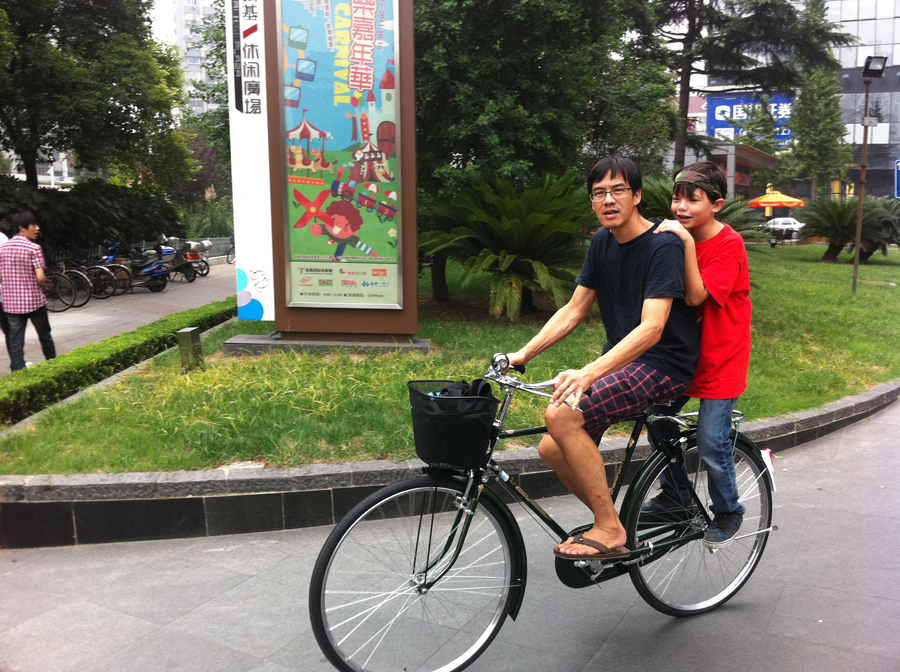
Here we are buying some foot pads from a mobile bicycle garage so I can ride on the back of dad's bike.


Wheeeeeeeee!!!

We rode and rode and rode and rode to get to the shop where I would get my bike. The first bike I tried was too big but the next one was okay.


This Phoenix bicycle that I got looked very shiny and I could just get my leg over the bar and it was very comfortable and safe. In the days to come I would enjoy going for long rides with my dad or slowly cycling up to our local market. The guy that sold me my bicycle was kind and thought I could learn how to ride the bigger bicycle. I decided on the one I knew how to ride instantly but I liked how nice the guy was. After we bought the bike dad got the nice guy to put two locks on the back of it. Then we thanked him and made the long but now shorter ride home.


No texting while biking.


You can get mauled by anything here in China. You can die by the hands of cars, buses, couples on scooters, little girls on tricycles, kittens on motorbikes . . . heck there are far too many combinations for me to tell you. The whole point is if you are cycling here you follow two rules. One: the bigger vehicle wins and two: keep moving no mater what unless it's a red light. Cyclists travel in mobs here. You will never see one or two lone rangers. I swear that people travel in packs of at least twenty when riding bikes. Anyway to sum that up probably the best thing to do is go to plan B (when in Rome) when traveling in a cycle mob.  

A Thousand Ways to Die by Bicycle in Shanghai


Bikers waiting to pounce on your mouse-like body.


The motorcycle street gang... drive by he hee hee!!


The guy who got you and the old lady with the chair waiting for you to step in front.


The serious dad and the four year old Chinese chainsaw massacre girl. Watch out for sharp blades.


Bamboo sticks ready to impale you.


Mobile garden of death. Keep an eye out for Venus fly traps.


Motorized war zone (sandbags). Does he have a gun?


Grim reaper furniture. Danger! Beware of flying chairs.


Death chairs. Much bigger than they look.


BUS!!!!!


This is Pam

Riding a bicycle here can feel scary because there's so much to look out for. People are turning right and left on bikes, motor scooters and big tricycles, in cars, trucks and buses. Every vehicle goes a different speed, so people are always passing each other – bikes pass walkers, cars pass scooters, etc. The streets are full of honking and ringing bells. It's not like the U.S., when people usually honk when they're mad. People just honk to let other people know they're coming. If you're riding your bike and hear a horn behind you, you know that someone in a car or on a scooter is about to pass you. They're warning you not to make any sudden moves.


This set of traffic signs might give you a sense of how complicated Shanghai traffic is. How many different messages can you find in the signs?

You are constantly making adjustments – slowing a bit here, speeding up a little there, making slight shifts in direction ­– to avoid running into people. Other people make their own adjustments to keep from running into you. No one wears a helmet (except for Parker), and they pile everything imaginable onto their bikes – laundry, groceries, furniture, appliances, family members, pets. We've seen several scooters with dogs riding on them, although we were never quick enough to take a picture.

But in some ways it feels safer than riding a bicycle on the street in the U.S. because bicycles are so common. In the U.S. you often feel that people in cars either don't see bicycles or get irritated by them. Not here in China, where they're everywhere.


There are special lanes as well as signals for bikes. People don't always pay attention to them – the bike lanes are full of motor scooters and pedestrians and parked cars as well as bikes – but they give you some protection.


You might wonder why I've put in a picture of a swimming pool. Well, we've had a similar experience with Chinese "traffic" in the Tongji University pool, where we go to swim about once a week. It's a beautiful, Olympic-sized pool, full of people swimming in all directions – up and back, across, diagonally, etc. There are lap lanes, but they're usually being used by classes. So if you want to swim laps, you have to be constantly ready to dodge around people coming from all directions, as well as the ones just standing around in the middle and talking or listening to instructors. It takes some extra energy, but if everyone pays attention, it usually works out all right. This seems to be a general Chinese approach to daily life. 


We bought bikes made by two of Shanghai's major bike manufacturers. Peter's bike came from the "Forever" company, founded in 1948. It cost 508 yuan. Parker's bike came from the "Phoenix" company, founded in 1958. It cost 390 yuan. Shanghai also makes the "Flying Pigeon," which is my favorite bike name.

I could have gotten a Flying Pigeon, but to save money, I didn't get a bike. When all three of us go out together, I ride Parker's bike and he rides on the back of Peter's bike. 


Before World War II, bikes were too expensive for most Chinese people. After the war, though, new factories opened, the Communist Party encouraged bike riding, and a lot more people bought them. Very few of them were used for recreation. They were basic transportation. In 1950, China began calling itself the "Kingdom of Bikes."

Now, however, bikes are becoming less popular, especially among younger people. As Parker said in his blog, those who can afford it would rather drive cars. If you ride a bike, it probably means you don't have enough money for a car, and young people don't like that. It's different from 20 years ago, when hardly anyone in China had a car.

While researching the history of bikes in China, I ran across an interesting article about changes in Chinese bike culture, and how a group of "expats" (short for "expatriots," which means people living outside their own country) is trying to get young Chinese people interested in bicycles again. They're trying to make bicycles "cool."


Check out the article. Do you think their ideas will work? What would you do to create interest in bicycles, either in China or here in the U.S.?


Sunday, October 9, 2011

My Chinese National Week


National Week is the Chinese Fourth of July that lasts all week. The web had said that the night before National Day (October 1) people get together and supposedly bop each other on the head with inflatable hammers and watch fireworks. Apparently the guy who wrote this on the web was a fraud. We didn’t find anyone else with hammers. 


Yet the upside was we watched one of the greatest firework shows in Asia (made up into two halves: the Portuguese who exited with a boom and the Germans who got it together).


I had gotten middle row seats the best place you could watch from. Yep there I was standing on the front of the back of a police pickup truck.


These are our good friends Jason and Gina, who were visiting for National Week. Which led to going to the exhibit


The art gallery that we visited used to be an electric switch factory and now had a knack for selling fancy Zippo lighters in its gift shop. 


The people in "Follow! Follow! Follow!" were made out of thread and had no faces . . . or lives.


Some were soldiers guarding tissue paper and parachuting out of airplanes. 


Others were civilians taking pictures next to beautiful buildings.


And the last chose to climb mountains for no particularly clear reason.

It makes me feel queasy to feel that the people climbing the mountain don't stand up for what they believe in. Just go along with everyone else. Just like the soldiers guarding the tissue paper.

Hang on a second . . . soldiers guarding tissue paper? Somehow, the paper just didn't look right.


I looked in the book about the artists that was on a desk, and sure enough the picture of the men was there . . . with no tissue paper. It was only two seconds before I decided what to do next.


Quicker than you could say "communism" the tissue paper was underneath the desk with the art book on it. 


Later when I came back the tissue paper was there sitting where I had picked it up from. At first I was scared out of my mind. When my mom called me over I thought I was really going to get it, but then the lady at the desk explained to me that it was OK. It turned out that at the last moment the artist had changed it so that the men were guarding the tissue paper. 


Why am I at the dentist? The night of the fireworks on the way home in the metro I cracked my tooth. I was chewing on some seaweed (which is delicious) and CRACK!!! I was the only one who heard it considering we were on a metro.

Two days later I was in the dentist's office. I was scared out of my mind. Dad kept saying "no pully pully" and I was really annoyed. In not very long I was getting seated for my checkup.

Now what I thought after I broke my tooth the dentist would cement glue the two pieces together and let the tooth come out naturally. After they sat me down and took some tests the assistant dentist brought over a little box. Peeking into it I expected to see thin cement glue... hang on a second is this a hospital or a garage? Inside the small tin box were fifteen different sizes of pliers... or were they yankers? Quicker than you could say "I shouldn’t have bit so hard" the smaller piece of the tooth was yanked out.        


This is Pam.

It was quite a busy National Week. My favorite part about the tooth story is the price. The dentist (who was very nice) worked at a big hospital. After she pulled the broken part of the tooth out, she sent us downstairs to pay. What did it cost? A whopping 9 yuan. You do the math.

I liked the "Follow! Follow! Follow!" exhibit a lot. It was especially interesting because of the way Chinese artists are using their art to ask questions about Chinese society today.

For decades, China's Communist Party ran everything and told everyone what to do. If people didn't go along with what the Party said, they could lose their jobs, be thrown in jail or even worse. The Party controlled everything. People got used to just going along with whatever the Party said.

Now, the economy is more competitive, and people are freer to act on their own. But one of the questions Chinese artists ask is whether Chinese people are actually acting more freely and independently, or whether they are just following a different set of pressures controlled by a different group of people. Are they just trying to do what will make them "popular"? Are they working hard so they can buy lots of stuff because advertisements for products tell them that stuff will make them happy? Here is a painting of an imaginary advertisement by one of the "Follow! Follow! Follow!" artists, Ji Wenyu. It's called "500 Grams of Nutritional Juice."


Looking at these works of art can help people ask questions about their society and themselves.

In the exhibit, I especially liked the piece called "Climb Up, Walk Steadily." It shows a group of men in business suits climbing up strings to a bar, and then trying to keep their balance once they get there. With no faces, they look hollow and empty and sad. Why are they climbing like that? 


To me, this piece could speak to people in the U.S. as well as in China. How many people in the U.S. just follow the ideas of others – friends, TV advertisements, radio show hosts, politicians, etc.?

You might think about your own life, or the lives of people around you. Can you relate to these artworks? Do you ever do things you don't really understand or don't agree with, just because someone else says you should? Do kids at Shamrock ever face peer pressure to act in certain ways? To "go along with the crowd"? If so, who pressures them? Why?

I was glad that Parker was willing to act on his own and take out the tissue paper, even though it turned out that the artist meant for it to be there. It really looked like some visitor had just stuck it there. It didn't cause any problems – it was easy to put back. It can be hard to decide to act independently, and I was glad Parker had the courage to do it. I think the artist would have liked it too.